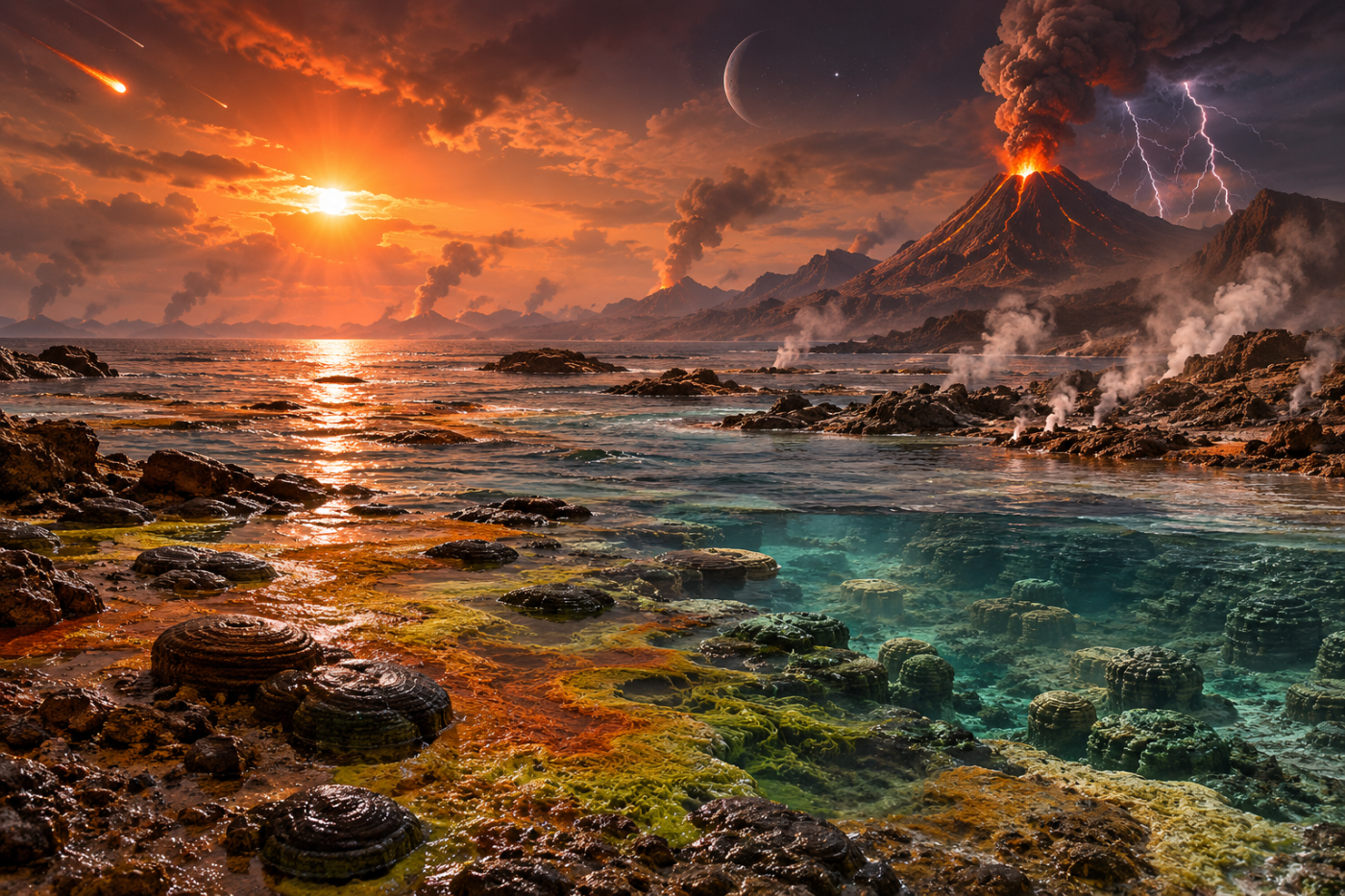
The Mesoarchean Era lasted from approximately 3.2 to 2.8 billion years ago and was the third era of the Archean Eon. During this time, Earth continued to cool and stabilize, allowing larger continental landmasses to develop and long-lasting oceans to cover much of the planet. Although the atmosphere still contained very little free oxygen, life in the oceans became more abundant and diverse than during earlier Archean eras.
One of the defining features of the Mesoarchean was the widespread growth of cyanobacteria, microscopic organisms capable of photosynthesis. These microbes formed extensive stromatolites—layered rock structures that are among the oldest visible fossils on Earth. While cyanobacteria released oxygen as a byproduct of photosynthesis, most of it reacted with dissolved iron and other chemicals in the oceans, preventing significant amounts from accumulating in the atmosphere.
The Mesoarchean also witnessed important geological developments. Earth's continental crust continued to expand through volcanic activity and plate tectonic processes, forming stable cratons that would become the cores of modern continents. Some of the oldest surviving continental rocks date from this era, providing valuable evidence of Earth's early geological evolution.
A major event near the end of the Mesoarchean was the formation of the Vredefort impact structure in present-day South Africa. Created by a massive asteroid impact approximately 3.02 billion years ago, it is considered one of the oldest and largest confirmed impact structures on Earth.
Despite these geological changes, life remained entirely microscopic. No plants, animals, fungi, or complex multicellular organisms had yet evolved. The oceans were inhabited by communities of bacteria and archaea that gradually transformed Earth's environment and laid the foundation for the future oxygenation of the atmosphere.
The Mesoarchean represents a significant stage in Earth's history, marking a period of increasing geological stability, expanding continents, and flourishing microbial ecosystems that would shape the evolution of life for billions of years to come.
Mesoarchean
The Mesoarchean was the third era of the Archean Eon, spanning 3.2 to 2.8 billion years ago, when Earth's continents expanded, microbial life flourished, and photosynthetic organisms became increasingly widespread.