The Rhyacian was the second era of the Proterozoic Eon, lasting from approximately 2.3 to 2.05 billion years ago. It followed the Siderian Era and was a time of profound environmental change as Earth's atmosphere became increasingly oxygen-rich. During the Rhyacian, the effects of the Great Oxidation Event continued to reshape the planet, while continents expanded, glaciers spread across much of the Earth, and microbial life diversified.
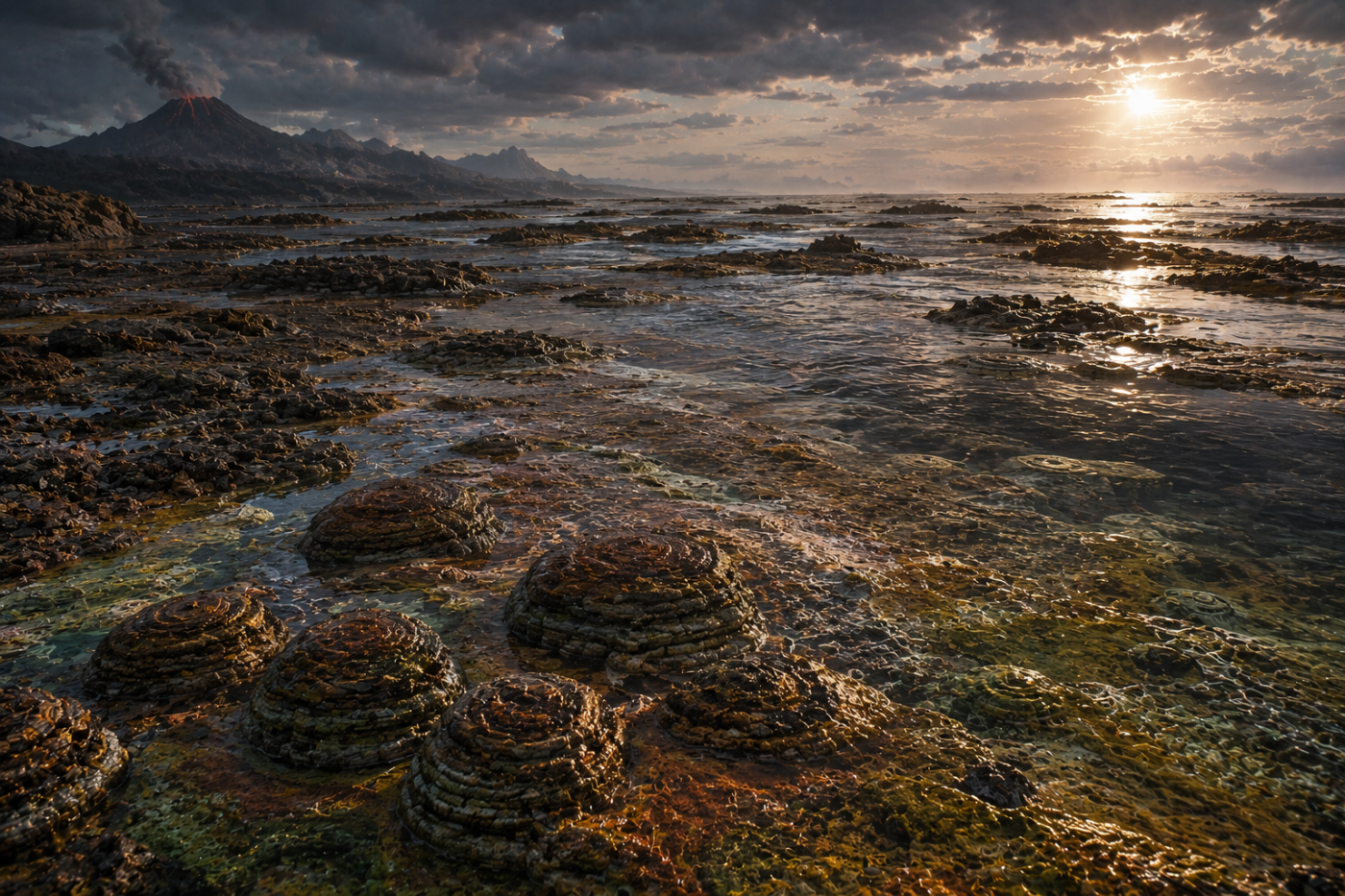
The name Rhyacian comes from the Greek word rhyax, meaning "stream of lava," referring to the widespread volcanic activity that characterized parts of the era. Although volcanism remained common, Earth's crust had become more stable than during the Archean, allowing large continental blocks to grow through tectonic collisions and mountain-building events. Many of today's ancient continental cores continued to develop during this time.
One of the defining features of the Rhyacian was the continuation of the Great Oxidation Event. Oxygen released by cyanobacteria gradually accumulated in the atmosphere after much of the dissolved iron in the oceans had already been oxidized. This marked the first time in Earth's history that free oxygen became a significant component of the atmosphere. Although oxygen levels were still only a small fraction of modern values, this transformation permanently changed Earth's chemistry and made the environment hostile to many anaerobic microorganisms that had previously dominated the planet.
The Rhyacian also witnessed the later stages of the Huronian Glaciation, one of the longest and most extensive ice ages known in Earth's history. Vast ice sheets covered large regions of the planet, dramatically altering sea levels, weather patterns, and global ecosystems. Scientists believe this glaciation was partly caused by the decline of atmospheric methane, a powerful greenhouse gas that was reduced as oxygen levels increased.
Life remained entirely microscopic, consisting primarily of bacteria and archaea. Cyanobacteria continued to build extensive stromatolites in shallow marine environments, producing oxygen through photosynthesis. Early eukaryotic cells, organisms with complex internal structures including a nucleus, may have appeared during or near the end of the Rhyacian, although the fossil evidence remains limited and is still being studied.
The oceans gradually became less rich in dissolved iron as oxygen reacted with it to form extensive banded iron formations. These deposits, formed during the Siderian and Rhyacian, remain among the world's most important sources of iron ore today.
The Rhyacian ended approximately 2.05 billion years ago, marking the beginning of the Orosirian Era. It represents a crucial stage in Earth's evolution, when rising oxygen levels, continental growth, and major climatic changes prepared the planet for increasingly complex forms of life in the Proterozoic.
Rhyacian
The second era of the Proterozoic Eon, marked by the Great Oxidation Event, widespread continental growth, and one of Earth's earliest major ice ages.