The Siderian was the first era of the Proterozoic Eon, lasting from approximately 2.5 to 2.3 billion years ago. It marked a major turning point in Earth's history, as the planet's atmosphere and oceans began to change dramatically due to the widespread activity of photosynthetic microorganisms. The Siderian is best known for the formation of extensive banded iron formations and the beginning of the Great Oxidation Event, one of the most significant environmental changes in Earth's history.
The name Siderian is derived from the Greek word sideros, meaning "iron," reflecting the enormous iron-rich rock formations that were deposited during this time. As oxygen produced by cyanobacteria entered the oceans, it reacted with dissolved iron, causing iron oxides to precipitate and settle on the seafloor. These alternating layers of iron-rich minerals and sediment formed the banded iron formations that today serve as one of the world's most important sources of iron ore.
During the Siderian, Earth's continents continued to stabilize and grow as tectonic activity reshaped the planet's surface. Ancient cratons expanded through volcanic activity, mountain building, and continental collisions. While volcanism remained common, it was generally less intense than during the Archean Eon.
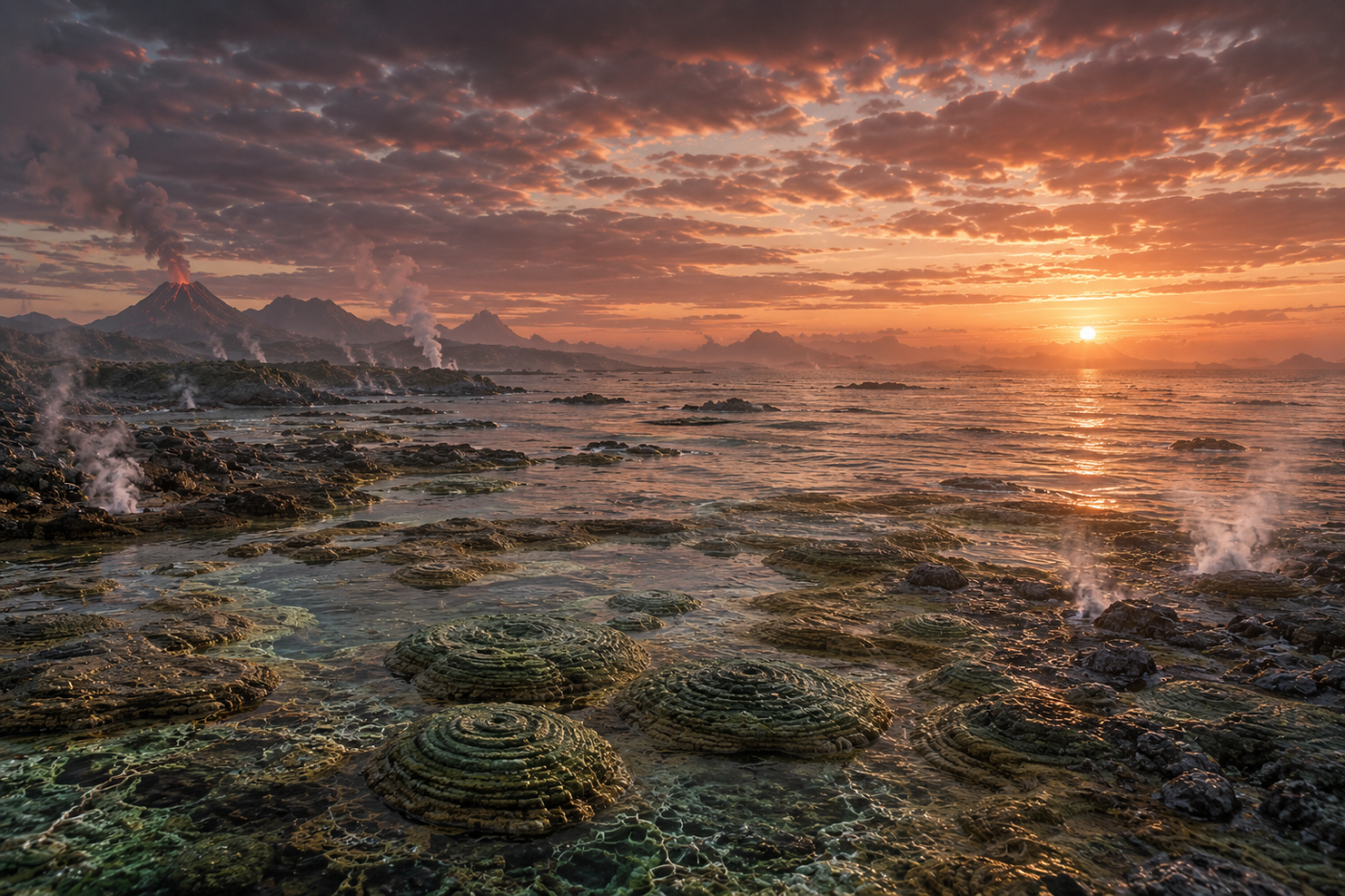
Life remained entirely microbial. Cyanobacteria flourished in shallow marine environments, forming extensive stromatolite reefs. Through oxygenic photosynthesis, these microorganisms released increasing amounts of oxygen into the oceans and atmosphere. At first, most of this oxygen reacted with dissolved iron and volcanic gases, but over time oxygen began to accumulate in the atmosphere. This gradual increase eventually triggered the Great Oxidation Event, fundamentally transforming Earth's environment and paving the way for more complex life.
The changing atmosphere also had major climatic consequences. As oxygen levels increased, atmospheric methane—a powerful greenhouse gas—declined because it reacted with oxygen. This reduction in greenhouse warming likely contributed to the Huronian Glaciation, one of Earth's earliest known and longest-lasting ice ages. During this period, glaciers spread across large portions of the planet, dramatically altering global environments.
Despite these environmental changes, no plants, animals, or fungi yet existed. Earth's ecosystems were dominated by bacteria and archaea living in oceans, coastal microbial mats, hydrothermal vents, and sediments. These microscopic organisms continued to drive the planet's biogeochemical cycles and fundamentally reshape Earth's atmosphere.
The Siderian ended approximately 2.3 billion years ago, giving way to the Rhyacian Era. It represents one of the most transformative periods in Earth's history, when oxygen-producing microbes permanently altered the chemistry of the oceans and atmosphere, creating the conditions necessary for the later evolution of complex multicellular life.
Siderian
The first era of the Proterozoic Eon, marked by the beginning of Earth's atmospheric oxygenation, the formation of vast iron deposits, and the earliest known global ice ages.