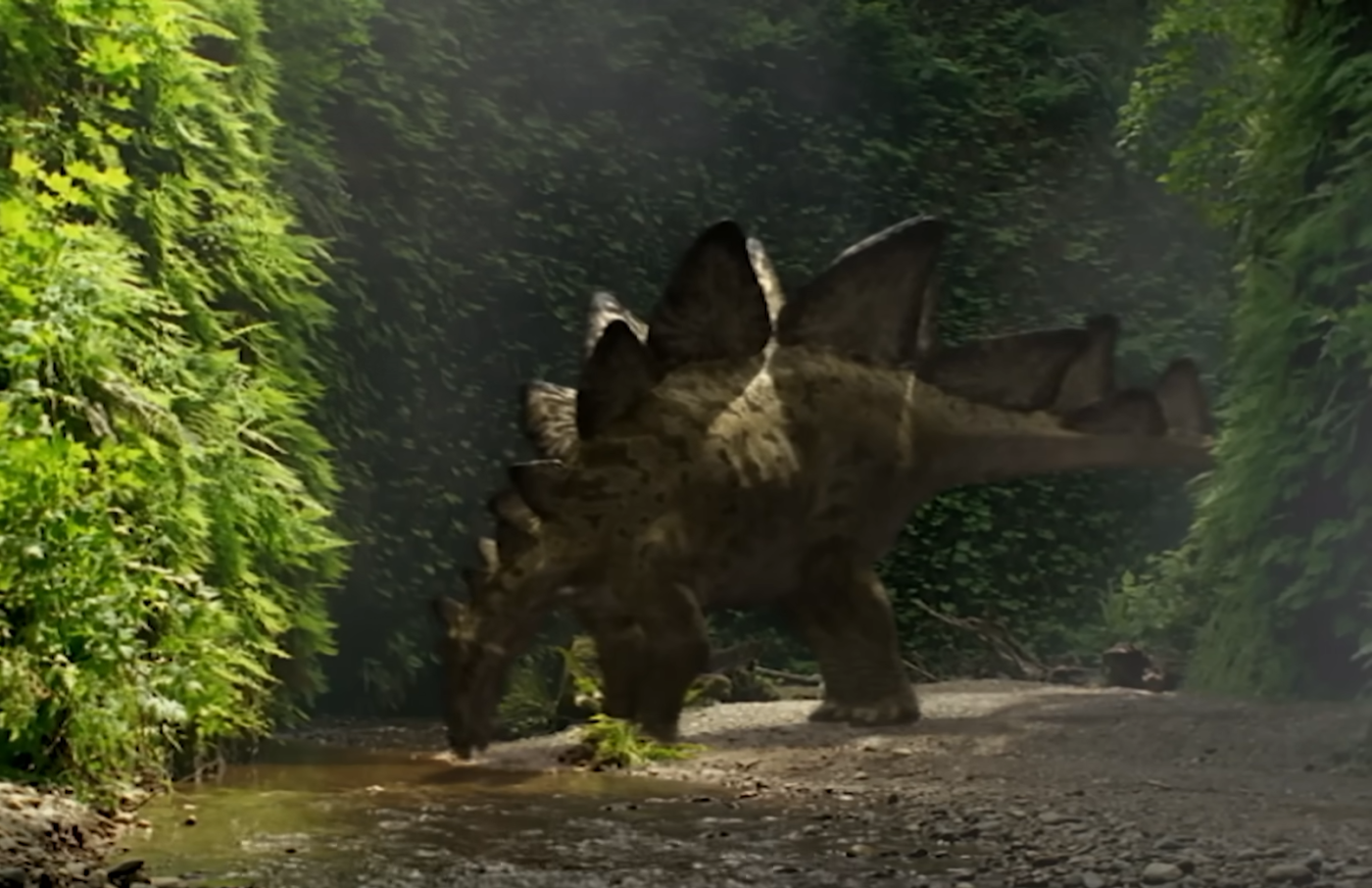
Stegosaurus was a large herbivorous dinosaur that lived during the Late Jurassic, approximately 155 to 145 million years ago. It belonged to the family Stegosauridae, a group of armored dinosaurs distinguished by the large plates running along their backs and the spiked tails they used for protection. Stegosaurus is one of the most recognizable dinosaurs and remains an icon of the Jurassic Period.
Adults measured up to 9 meters (30 feet) in length and weighed between 5 and 7 metric tons. It walked on four sturdy legs, with longer hind legs than front legs, giving its back a distinctive sloping appearance. Despite its enormous size, Stegosaurus had a relatively small skull and brain compared to its body, though its nervous system was well adapted for controlling its movements.
The dinosaur's most distinctive features were the two alternating rows of large, kite-shaped bony plates extending from its neck to the end of its back. Scientists believe these plates were likely used for display, species recognition, and regulating body temperature by helping dissipate heat, although their exact function is still debated. At the end of its muscular tail were four long spikes, commonly known as the thagomizer, which served as a formidable defensive weapon against predators.
Stegosaurus inhabited floodplains, forests, and open woodlands across what is now western North America. As a herbivore, it fed on low-growing vegetation such as ferns, cycads, horsetails, shrubs, and other primitive plants. Its narrow beak allowed it to strip leaves from plants, while its small cheek teeth were adapted for slicing rather than chewing.
Stegosaurus shared its environment with some of the largest dinosaurs of the Jurassic, including Allosaurus, Diplodocus, Apatosaurus, Brachiosaurus, and Camarasaurus. Fossil evidence suggests that the spikes on its tail were effective defensive weapons, with some Allosaurus fossils showing injuries that may have been inflicted by Stegosaurus.
The first Stegosaurus fossils were discovered in 1877 in Colorado during the famous Bone Wars, and the dinosaur was formally named by paleontologist Othniel Charles Marsh. Since then, numerous skeletons have been uncovered, allowing scientists to reconstruct its appearance, growth, and behavior with remarkable accuracy.
Stegosaurus became extinct around 145 million years ago near the end of the Jurassic Period, long before the extinction of the non-avian dinosaurs. Today, it remains one of the best-known dinosaurs and provides valuable insight into the evolution of armored herbivorous dinosaurs.
Stegosaurus
A large herbivorous dinosaur recognized by the two rows of bony plates along its back and the spiked tail it used for defense during the Late Jurassic.