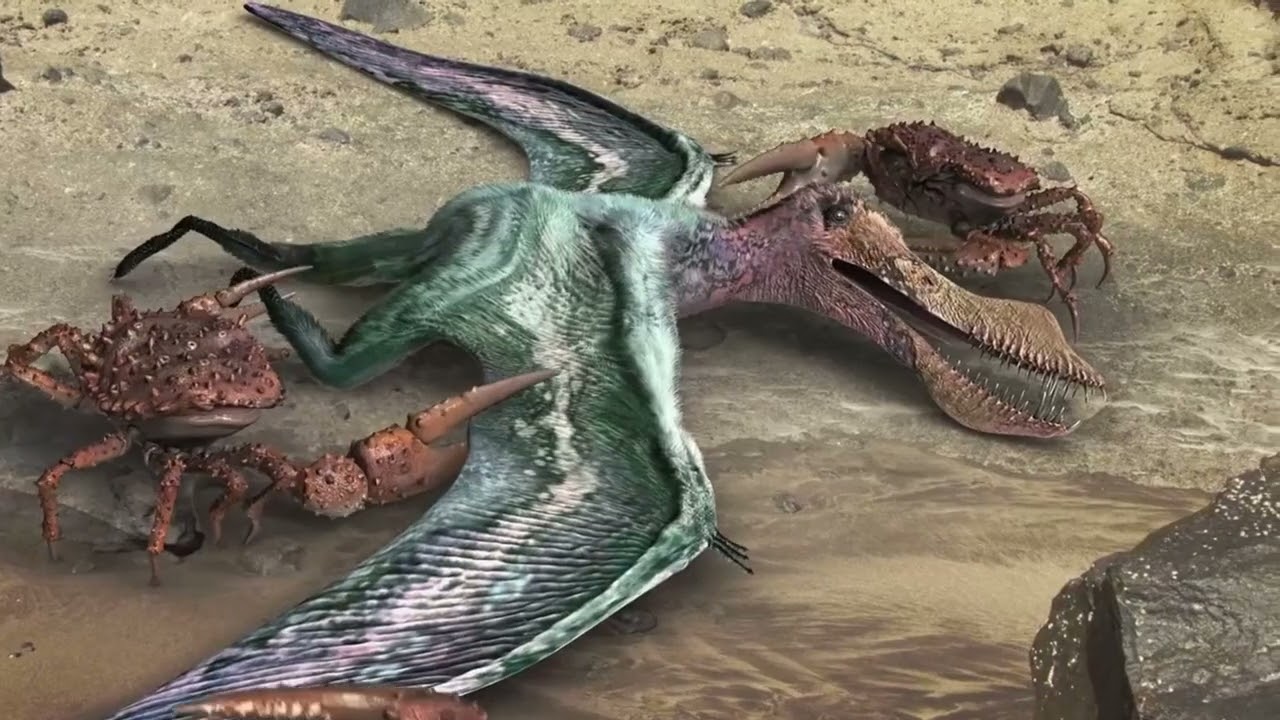
Anhanguera was a large ornithocheirid pterosaur that lived during the Early Cretaceous Period, approximately 112–94 million years ago. It was discovered in Brazil, particularly in the Santana Formation, one of the world's most important fossil sites for preserving pterosaurs.
Although often grouped with dinosaurs in popular culture, Anhanguera was not a dinosaur but a flying reptile that lived alongside them. It had a long, narrow skull with a pointed beak and numerous sharp teeth designed for catching slippery prey such as fish.
Anhanguera had a large wingspan estimated at around 4–6 meters (13–20 feet) and a lightweight body supported by hollow bones. Like other pterosaurs, it flew using a wing membrane stretched between its elongated fourth finger and body.
Its distinctive feature was the expanded crest on its snout and lower jaw, which may have been used for display, species recognition, or improving flight stability. Anhanguera likely spent much of its time flying above coastal waters, hunting fish similar to modern seabirds.
Anhanguera
Anhanguera was a large flying pterosaur from the Early Cretaceous known for its long tooth-filled jaws and fish-eating lifestyle.