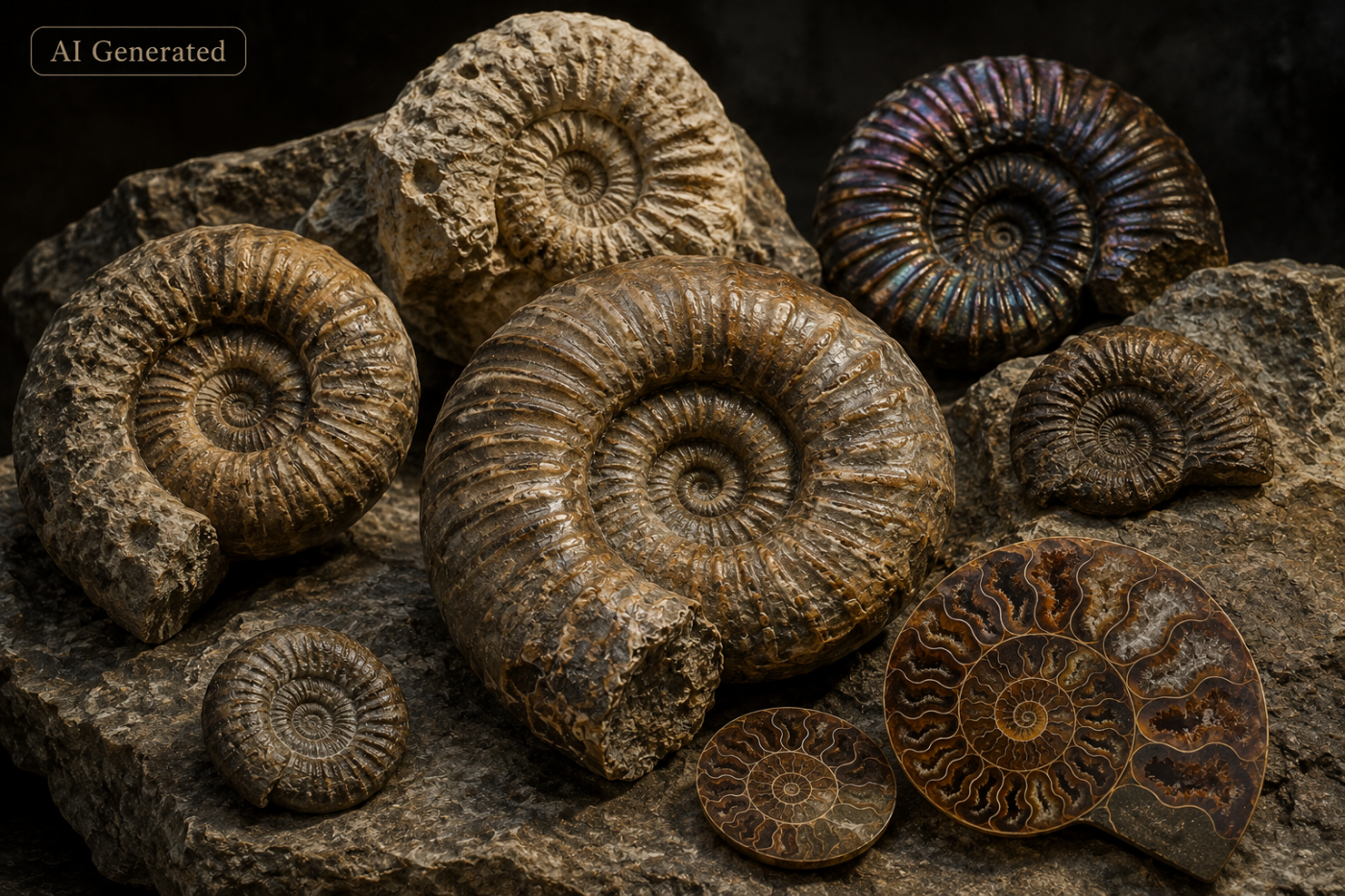
Ammonites were an extinct group of marine cephalopods belonging to the subclass Ammonoidea. They first appeared during the Devonian Period, around 409 million years ago, and became one of the most successful and diverse groups of marine animals in Earth's history. Although they resembled the modern nautilus because of their coiled shells, ammonites were more closely related to today's squids, octopuses, and cuttlefish.
Their shells were divided into a series of chambers separated by walls called septa. As the ammonite grew, it built larger chambers while sealing off the older ones. These chambers contained gas and liquid, allowing the animal to control its buoyancy and move through the ocean. The shell's intricate suture patterns, where the septa met the outer shell, are unique to different species and are widely used by paleontologists for identification.
Ammonites inhabited oceans across the globe, from shallow tropical seas to deeper marine environments. They were active predators and scavengers, feeding on small fish, crustaceans, plankton, worms, and other marine invertebrates using their tentacles and a hard beak.
Because ammonites evolved rapidly and were geographically widespread, they are among the most important index fossils. Their fossils allow geologists to accurately determine the age of sedimentary rock layers and reconstruct ancient marine environments. Thousands of species have been described, displaying an enormous variety of shell shapes, sizes, and ornamentation, including ribs, spines, and nodules.
Ammonites reached their greatest diversity during the Jurassic and Cretaceous periods. They became extinct approximately 66 million years ago during the Cretaceous–Paleogene (K–Pg) mass extinction, the same event that eliminated the non-avian dinosaurs. Today, ammonite fossils are among the most common and recognizable fossils in the world and are highly valued by collectors and scientists alike.
Ammonite
An extinct group of marine cephalopods with spiral shells that thrived for over 340 million years before becoming extinct 66 million years ago.