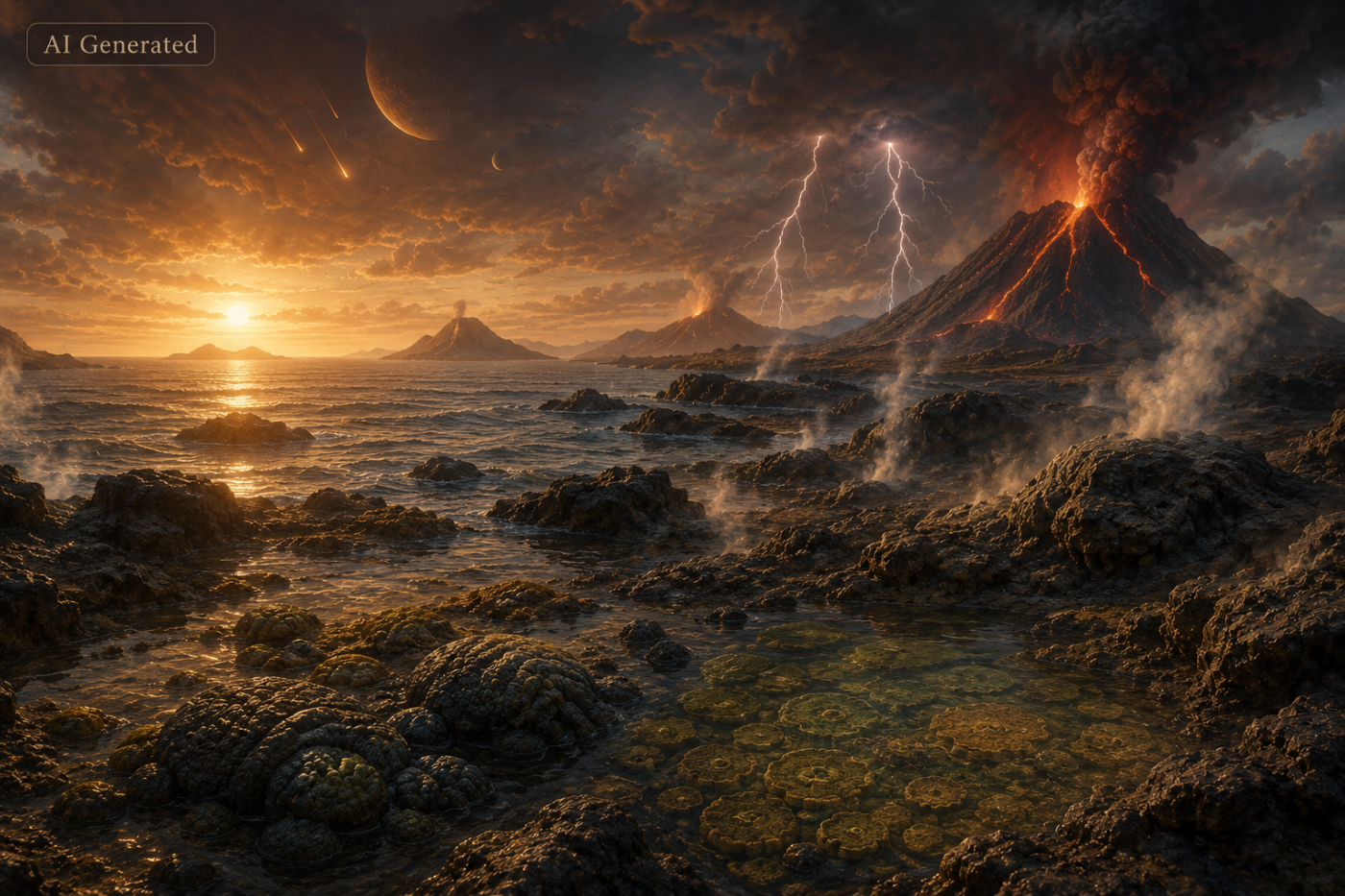
The Eoarchean Era lasted from approximately 4.0 to 3.6 billion years ago and marks the beginning of the Archean Eon. It was a crucial period in Earth's history, during which the young planet transitioned from a hostile, heavily bombarded world into one with a more stable crust and the first long-lasting continents.
By the start of the Eoarchean, much of the intense asteroid bombardment that characterized the earlier Hadean Eon had begun to decline. Earth's surface cooled sufficiently for permanent oceans to form, while volcanic activity remained widespread as the planet's interior was still significantly hotter than it is today. The atmosphere contained almost no free oxygen and was composed mainly of carbon dioxide, nitrogen, water vapor, methane, and other volcanic gases.
The oldest known rocks on Earth date from the Eoarchean, including the Acasta Gneiss in northwestern Canada, which is approximately 4.03 billion years old. These ancient rocks provide valuable evidence of the formation of Earth's early continental crust and the geological processes that shaped the young planet.
The Eoarchean may also represent the earliest chapter in the history of life. Evidence from ancient rocks in Greenland suggests that simple microorganisms may have existed as early as 3.8 to 3.7 billion years ago, although this evidence remains the subject of scientific debate. If confirmed, these organisms would have been microscopic, single-celled life forms living in the oceans, likely obtaining energy through chemical reactions rather than photosynthesis.
Although no complex plants or animals existed during this era, the Eoarchean laid the foundations for all future life by establishing stable oceans, continental crust, and environmental conditions capable of supporting primitive microorganisms. It represents one of the most important stages in Earth's geological evolution, bridging the transition from a lifeless young planet to one capable of sustaining life.
Eoarchean
The Eoarchean was the earliest geological era of the Archean Eon, spanning from 4.0 to 3.6 billion years ago, when Earth's crust stabilized, the first oceans existed, and the earliest evidence of life may have appeared.