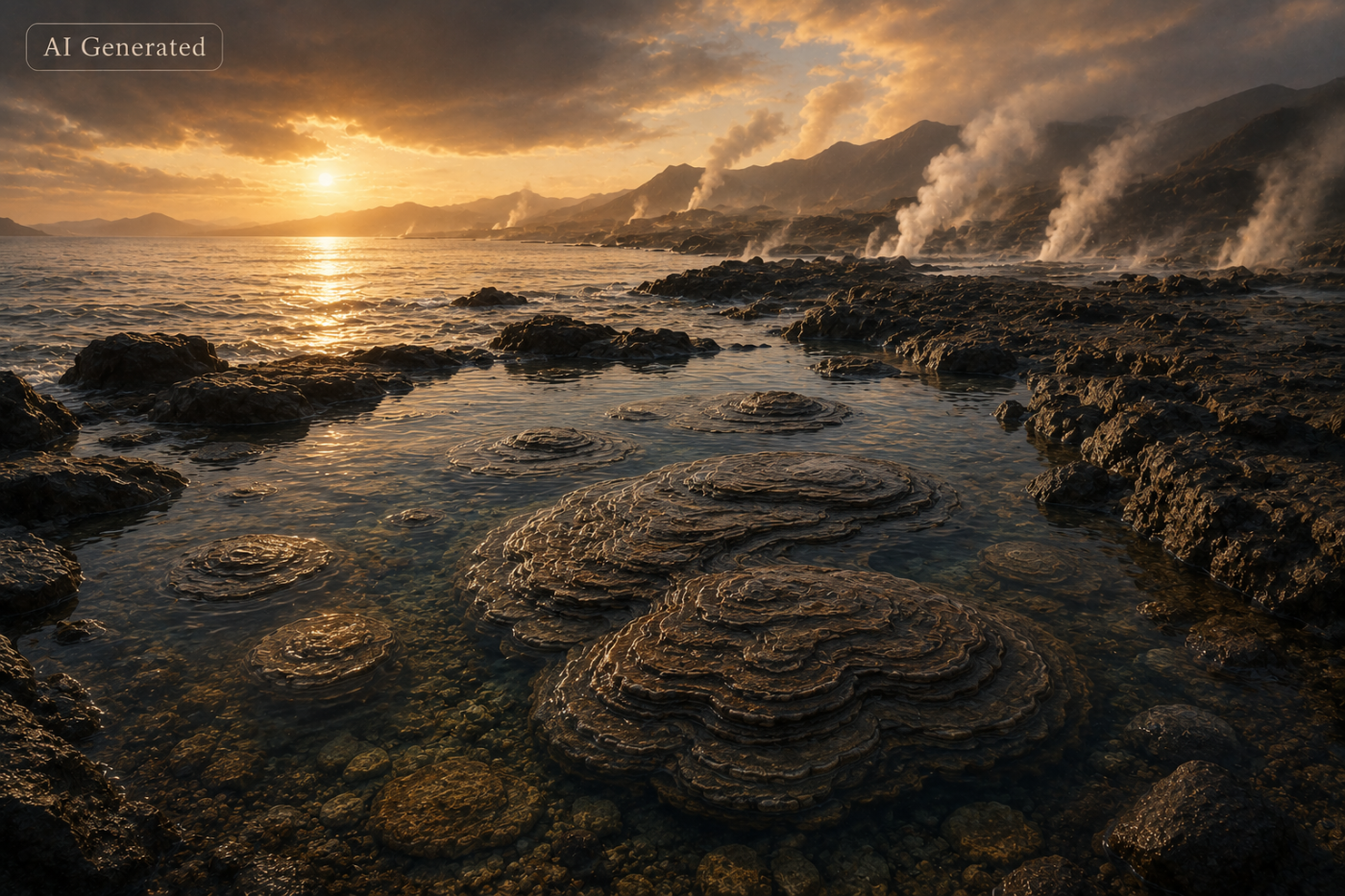
The Paleoarchean Era lasted from approximately 3.6 to 3.2 billion years ago and represents the second era of the Archean Eon. During this time, Earth became increasingly stable as continental crust continued to grow, oceans covered much of the planet, and volcanic activity remained widespread. Although the atmosphere still contained almost no free oxygen, conditions had become suitable for the earliest confirmed forms of life to thrive.
One of the most significant developments of the Paleoarchean was the appearance of stromatolites, layered rock structures created by colonies of microorganisms known as cyanobacteria. Fossil stromatolites dating to around 3.5 billion years ago provide some of the oldest widely accepted evidence of life on Earth. These microbes lived in shallow marine environments, where they trapped sediment and slowly built layered structures over thousands of years.
Despite the presence of cyanobacteria, Earth's atmosphere remained largely oxygen-free because the oxygen produced through photosynthesis was absorbed by dissolved iron and other chemical compounds in the oceans. It would take hundreds of millions of years before oxygen began accumulating in the atmosphere during the Great Oxidation Event.
The Paleoarchean also saw continued growth of the earliest continents through volcanic activity and plate tectonic processes. Ancient rock formations from this era, found in regions such as South Africa, Australia, and Greenland, preserve valuable evidence of Earth's early crust, oceans, and primitive ecosystems.
No plants, animals, or complex multicellular organisms existed during the Paleoarchean. Life consisted entirely of microscopic single-celled organisms living in marine environments. Nevertheless, these early microbes fundamentally changed Earth's chemistry and laid the foundation for the evolution of all later life.
Today, the Paleoarchean is recognized as one of the most important periods in Earth's history, marking the emergence of well-preserved fossil evidence and the establishment of ecosystems that would shape the planet for billions of years.
Paleoarchean
The Paleoarchean Era lasted from approximately 3.6 to 3.2 billion years ago and represents the second era of the Archean Eon.