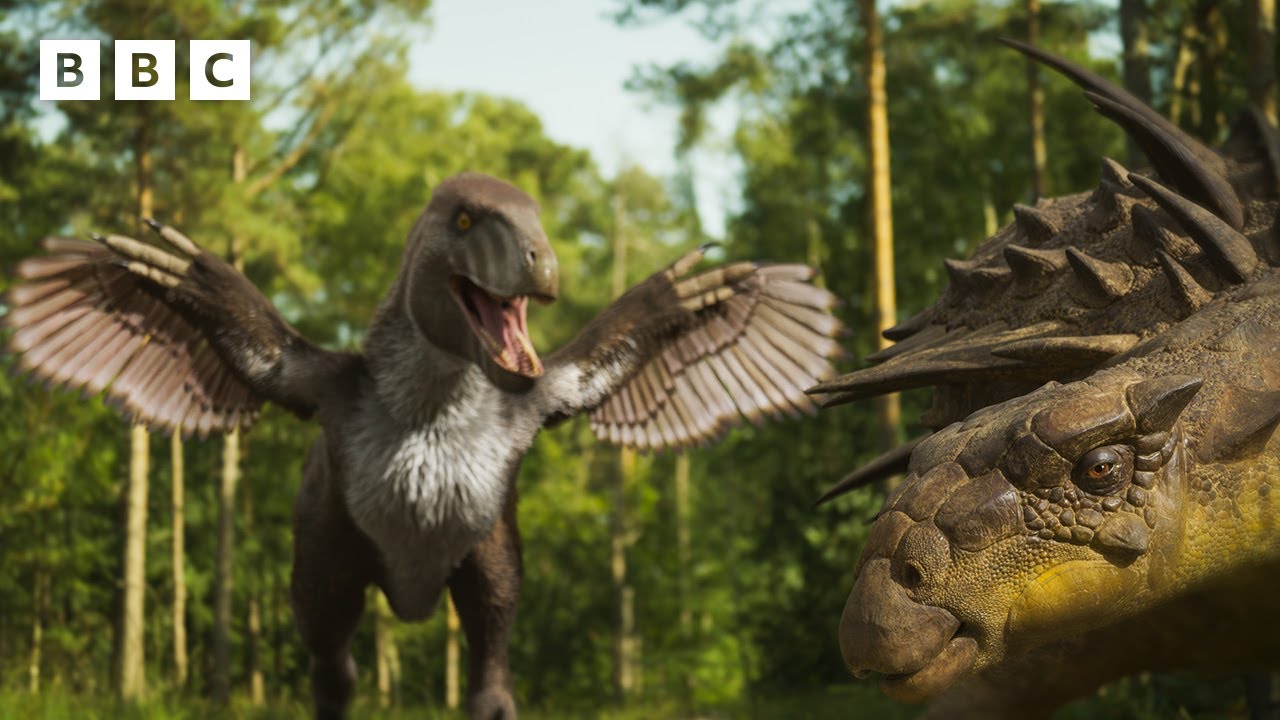
Utahraptor was a large carnivorous dinosaur that lived during the Early Cretaceous, approximately 135 to 130 million years ago. It belonged to the family Dromaeosauridae, a group of agile, feathered theropods commonly known as "raptors." Unlike the smaller Velociraptor, Utahraptor was the largest known member of its family, making it one of the most formidable predators of the Early Cretaceous.
Adults measured up to 7 meters (23 feet) in length, stood around 2 meters (6.5 feet) tall at the hips, and weighed between 500 and 700 kilograms (1,100–1,500 pounds). Its body was built for both strength and agility, featuring powerful hind legs, grasping forelimbs with large claws, and a long, stiff tail that provided balance while running and turning.
Like all dromaeosaurs, Utahraptor possessed an enlarged, sickle-shaped claw on the second toe of each foot. These claws could reach over 22 centimeters (9 inches) in length and were likely used to grip, slash, or pin down prey. Fossil evidence and comparisons with closely related species strongly suggest that Utahraptor was covered in feathers, even though it was too large to fly. The feathers probably served for insulation, display, and protecting eggs rather than flight.
Utahraptor inhabited forests, river floodplains, and open woodlands in what is now Utah, United States. As an apex predator, it hunted a variety of herbivorous dinosaurs, including Iguanodon-like ornithopods, young sauropods, and other medium-sized reptiles. Some fossil discoveries suggest that multiple Utahraptor individuals may have died together, leading to speculation that they occasionally hunted or fed in groups, although this remains uncertain.
The first Utahraptor fossils were discovered in 1991 in eastern Utah, and the species Utahraptor ostrommaysorum was formally described in 1993. Its discovery significantly changed scientists' understanding of dromaeosaurs by revealing that giant "raptors" existed long before the appearance of the much smaller Velociraptor made famous by popular media.
Utahraptor became extinct around 125 million years ago, disappearing long before the end of the Cretaceous Period. Although it did not witness the Cretaceous–Paleogene (K–Pg) mass extinction, it remains one of the most impressive predators of the Early Cretaceous and provides important evidence of the diversity and evolution of feathered dinosaurs.
Utahraptor
A large, fast, feathered predator that lived during the Early Cretaceous and was the largest known member of the dromaeosaur, or "raptor," family.