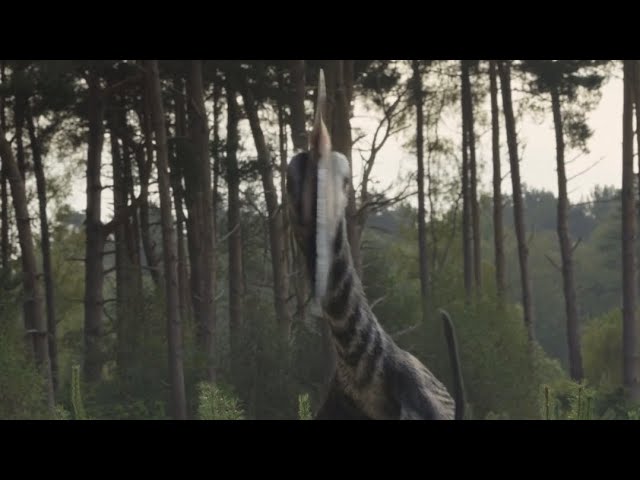
Hatzegopteryx was a giant flying reptile that lived during the Late Cretaceous, approximately 72 to 66 million years ago. It belonged to the family Azhdarchidae, a group of enormous toothless pterosaurs that included some of the largest flying animals in Earth's history. Although it lived alongside dinosaurs, Hatzegopteryx was not a dinosaur, but a flying reptile closely related to other pterosaurs such as Quetzalcoatlus.
With an estimated wingspan of 10 to 12 meters (33–39 feet), Hatzegopteryx ranked among the largest known flying animals. Unlike many other giant azhdarchids, it possessed an exceptionally short, broad, and heavily built skull that may have exceeded 3 meters (10 feet) in length. Its neck vertebrae were remarkably thick and robust, indicating that it could withstand powerful forces while capturing and handling large prey.
Hatzegopteryx lived on Ha?eg Island, a large island that existed in what is now Romania during the Late Cretaceous. This isolated ecosystem was home to many unusual animals, including dwarf dinosaurs that evolved smaller sizes because of limited island resources. As one of the largest predators on the island, Hatzegopteryx likely occupied the role of apex predator, hunting animals that ranged from small vertebrates to juvenile dinosaurs.
Unlike seabirds, Hatzegopteryx is thought to have spent much of its time walking across open landscapes on all four limbs, using its long legs to travel efficiently. It probably hunted by stalking prey before striking with its enormous, spear-like beak, swallowing smaller animals whole or tearing apart larger prey with powerful neck muscles.
The first fossils of Hatzegopteryx were discovered in Romania and formally described in 2002. Although only partial remains have been found, including portions of the skull and upper arm bone, these fossils reveal one of the strongest and most heavily built pterosaurs ever discovered. Scientists believe its anatomy differed significantly from that of other giant pterosaurs, making it uniquely adapted for hunting large terrestrial prey.
Hatzegopteryx became extinct approximately 66 million years ago during the Cretaceous–Paleogene (K–Pg) mass extinction, the same event that eliminated the non-avian dinosaurs and all other pterosaurs. Today, it is regarded as one of the most impressive flying reptiles ever discovered and provides valuable insight into the evolution of giant pterosaurs and the unique ecosystems of Late Cretaceous island environments.
Hatzegopteryx
A gigantic flying reptile with a massive skull that lived during the Late Cretaceous and was one of the largest pterosaurs ever discovered.